


Every institution has a reputation already in motion — whether anyone’s steering it or not. The dangerous assumption is thinking good work automatically translates into good perception. It doesn’t. What follows is a look at what actually shapes how people see a leader or organization, why waiting until a crisis to think about it is a losing move, and what it actually looks like to get ahead of it.
That gap is more common than most executives admit. And it’s rarely about bad intentions on anyone’s part. It’s about who’s actually shaping the story while you’re busy running the thing the story is about.
Here’s what we’ll cover:
- Why your reputation probably isn’t as “in your control” as you assume
- What actually shapes how people perceive an institution or leader
- The moment this stops being theoretical and starts being urgent
- How to build a story that holds up under pressure
- What this looks like when it’s done well
Why your reputation isn’t as in-control as you think
Most leaders think of reputation as a byproduct. Do good work, communicate honestly, and the perception takes care of itself.
It doesn’t. Not anymore.
Journalists, regulators, employees, investors, and the public are all forming impressions from fragments — a quote pulled out of context, a delayed statement, a pattern of silence during a hard quarter. None of them are getting the full picture. They’re getting whatever’s loudest, fastest, or most repeated.
If nobody’s actively shaping that pattern, it gets shaped anyway. Just not by you.
What actually shapes how people see an institution or leader
It’s tempting to think this comes down to PR — press releases, a few interviews, maybe a crisis statement when things go sideways. But that’s a fraction of it.
What actually moves perception is consistency over time. Does what you say line up with what you do, quarter after quarter? Do your public statements, your internal culture, and your actual decisions tell the same story — or three different ones?
Institutions with strong reputations aren’t the ones with the flashiest messaging. They’re the ones where the story holds together under pressure, because it was never disconnected from reality in the first place.
That’s the real work: aligning what’s true, what’s said, and what’s seen — consistently, across every channel, before anyone’s forced to test it.
The moment this becomes urgent
Most leaders don’t think about narrative until they’re in a crisis. A lawsuit. A leadership change. A regulatory inquiry. A viral post that’s gaining momentum faster than anyone can respond to it.
That’s the worst possible time to start building a story from scratch. Reactive communication, written under pressure, almost always reads as reactive — defensive, vague, or overcorrected.
The institutions that come out of a crisis intact are usually the ones that had already done the groundwork. They had a clear, consistent narrative in place before the pressure hit, so the crisis response was an extension of something real — not an invention.
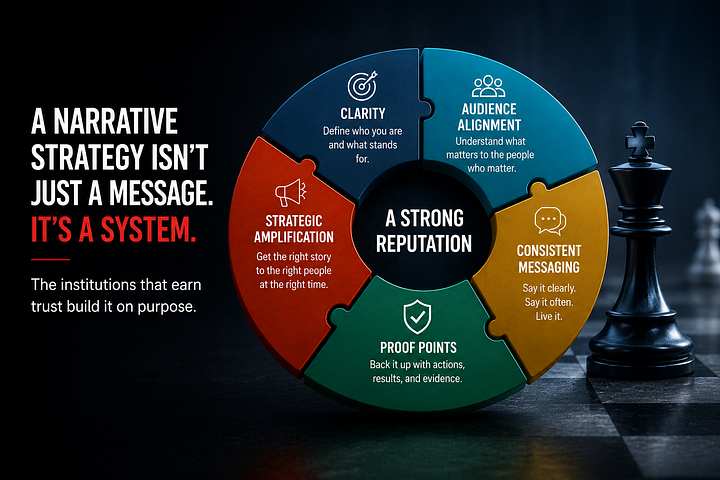
How institutions build a story that holds up
This is where Spred Global Communications comes in, and where a real International Reputation Management, Strategy and Communications approach earns its name. It’s not about writing better press releases. It’s about building the underlying architecture — narrative control, reputation infrastructure, and a clear-eyed read on how the institution is actually perceived versus how it wants to be perceived.
A few things this actually involves:
- Mapping the gap between internal reality and external perception, honestly
- Getting every stakeholder-facing message — leadership, comms, legal, investor relations — pointed the same direction
- Building crisis-readiness before there’s a crisis, not during one
- Identifying where the institution can lead a conversation instead of reacting to one
None of this is glamorous. It’s closer to infrastructure work than storytelling in the traditional sense. But it’s the difference between an institution that gets defined by others and one that defines itself.
What this looks like in practice
Picture a mid-sized institution facing a leadership transition — the kind of moment that tends to invite speculation. Without preparation, the story fills in with rumor, anonymous quotes, and worst-case assumptions.
With the right groundwork, the institution controls the timeline: internal alignment happens first, key messages are consistent across every spokesperson, and the public narrative is anchored in facts the institution chose to lead with — not facts a reporter had to dig for.
Same event. Completely different outcome. The difference wasn’t luck. It was preparation.
A few common questions
Isn’t this just PR with a different name?
Not quite. Traditional PR is often about securing coverage. This is about the underlying story that all that coverage — and every other stakeholder touchpoint — draws from. PR is one output of it, not the whole thing.
Do we only need this during a crisis?
The strongest reputations are built long before a crisis hits. Crisis response is just one test of whether the groundwork was done.
Who actually needs to be involved?
Usually more people than expected — not just communications, but leadership, legal, and sometimes HR. Reputation isn’t owned by one department; it’s shaped by all of them, whether they realize it or not.
Bottom line
Your institution already has a reputation. The only real question is whether you’re the one shaping it, or whether you’re finding out what it is after someone else has written it for you. Getting ahead of that isn’t optional anymore — it’s just good leadership.
 Sesus Blog — Smart Moves for Founders and Modern Marketers
Leave a comment