


Most executives don’t lose their teams in a single dramatic moment. They lose them one unclear email at a time.
A priority gets announced in a board meeting. It filters down through three layers of management, picking up interpretation and guesswork at every stop. By the time it reaches the people actually doing the work, it’s a rumor dressed up as a directive. Nobody’s lying. Nobody’s hiding anything. The strategy just never had a communication plan attached to it.
This is the quiet failure mode behind most organizational drift. Leadership assumes that because something was said once, it was understood. It rarely is. And when a crisis hits — the kind that makes headlines instead of hallway chatter — that same gap between what leaders mean and what stakeholders hear becomes the difference between a company that recovers and one that doesn’t.
An executive communication strategy exists to close that gap, deliberately and repeatedly, not just when things go wrong.
What Executive Communication Really Means (Beyond Town Halls and Memos)
Ask ten people to define executive communication and you’ll get ten different answers, most of them too narrow. A town hall is a channel. A memo is a format. Neither one is a strategy.
Executive communication is the discipline of deciding what leadership needs to say, to whom, through which channel, and how often — so that priorities move through an organization without losing their shape. It covers internal alignment (what employees need to understand to act with confidence) and external positioning (what investors, media, regulators, and the public need to hear to trust the direction a company is heading).
The mistake most leaders make is treating communication as an event instead of a system. A single well-crafted speech doesn’t build understanding. A single press release doesn’t build trust. What builds both is consistency — the same priorities, reinforced through the right channels, on a cadence the organization can actually absorb.
Why Misalignment at the Top Costs More Than You Think
Misalignment doesn’t announce itself. It shows up as missed deadlines nobody can quite explain, teams working at cross-purposes, and a slow erosion of confidence that’s hard to trace back to a single cause. By the time leadership notices, the cost has already compounded.
The stakes are measurable. Poor communication is one of the biggest drivers of disengagement inside organizations, and disengaged teams are slower, less innovative, and more expensive to retain. On the external side, the cost shows up differently — in how quickly stakeholders lose confidence when a company’s public messaging doesn’t match its actions, or when leadership goes quiet at exactly the moment people are looking for direction.
This is where stakeholder trust and alignment stops being a soft metric and starts showing up on the balance sheet. Investors price in leadership credibility. Employees price in whether they believe what they’re told. Customers price in whether a brand’s public voice matches its private conduct. None of that is intangible — it’s just harder to see until it’s already been lost.
The Core Pillars of a Communication Strategy That Holds Under Pressure
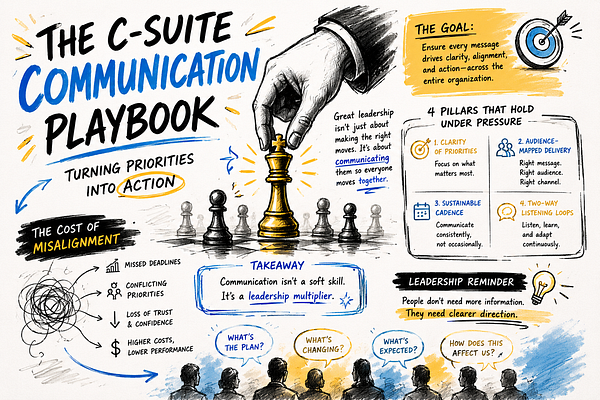
A durable executive communication strategy is built on four things working together, not in isolation.
Clarity of priorities. Before anything gets communicated, leadership has to agree internally on what actually matters right now. Strategies that try to communicate everything communicate nothing. The organizations that do this well can name their top three priorities in a single sentence — and every leader gives the same answer.
Audience-mapped delivery. A message crafted for the board rarely lands the same way with frontline employees, and a statement built for media won’t resonate with regulators. Effective delivery means adjusting tone, depth, and channel for each audience without changing the substance of the message itself.
Sustainable cadence. Communication that only shows up during a crisis or a major announcement trains people to tune out in between. A cadence leadership can actually sustain — weekly, monthly, quarterly, whatever fits the organization’s rhythm — builds the habit of listening before it’s urgently needed.
Two-way listening loops. The strategies that hold up under pressure aren’t one-directional. They include a mechanism for leadership to hear what’s landing and what isn’t — surveys, skip-level conversations, sentiment tracking — and they actually adjust based on what comes back.
This is the kind of executive communications strategy work that firms like Spred Global Communications build for leadership teams who need more than a messaging document — they need a system that holds together when priorities shift or pressure increases.
Where Most Strategies Break — The Crisis Test
Here’s the uncomfortable truth: most executive communication strategies are never actually tested until a crisis forces the issue. And that’s exactly when the gaps show.
The research on this is more specific than most leaders expect. One analysis of crisis media coverage found that CEO-fronted apologies increase neutral framing of a story by roughly 29 percentage points, while CEO-issued denials intensify negative framing by about 15 points. In other words, the choice to have a leader speak directly — and the honesty of what they say — measurably shapes how a crisis gets covered and remembered. Silence or evasiveness from the top isn’t neutral. It actively makes things worse.
Crisis communication, at its core, is the strategic management of how an organization responds to events that threaten its reputation, operations, or stakeholder trust — but it only works if the underlying communication infrastructure already exists. Organizations that try to build trust for the first time in the middle of a crisis are starting from a deficit. The ones that recover fastest are the ones where crisis communication planning was already part of how leadership operated, long before anything went wrong.
This is also where the difference between a communications plan and communications infrastructure becomes obvious. A plan is a document that sits in a drive somewhere. Infrastructure is a set of relationships, channels, and trained instincts that activate automatically when pressure hits. Spred builds toward the latter, specifically because the former tends to fail exactly when it’s needed most.
Building the Infrastructure — Not Just a Plan
Treating executive communication as infrastructure changes how it gets resourced. A plan gets written once and revisited annually. Infrastructure gets maintained continuously — monitored, stress-tested, and adjusted as the organization, its stakeholders, and the media landscape evolve.
This distinction matters most for organizations operating at scale, where the cost of a single misaligned statement can ripple across markets, regulators, and public perception simultaneously. Building reputation intelligence into the way leadership communicates — understanding not just what to say but how it will be received, by whom, and through which channel — turns communication from a reactive function into a strategic advantage.
Practically, this looks like: pre-approved messaging frameworks for common scenarios, a mapped stakeholder hierarchy so nobody is left uninformed, spokesperson training that goes beyond media-day prep, and monitoring systems that flag emerging issues before they become headlines. None of this replaces judgment in the moment — it just means leadership isn’t building the plane while flying it.
How to Know If Your Executive Communication Strategy Is Actually Working
Most organizations measure communication by output — how many town halls happened, how many emails went out, how many press releases were issued. None of that tells you whether anyone actually understood, believed, or acted on what was said.
Better indicators look at comprehension and behavior: Can employees at different levels articulate the same top priorities in their own words? Does sentiment data show alignment moving in the right direction after a major announcement, or is it flat? When a leader speaks publicly, does coverage reflect the intended message, or does it get reframed by someone else’s narrative? Are stakeholders asking fewer clarifying questions over time, or more?
An executive communication strategy that’s working shows up as quiet consistency — fewer surprises, faster alignment after change, and a leadership voice that stakeholders trust even when the news isn’t good.
Getting This Right Isn’t Optional Anymore
The organizations that treat executive communication as an afterthought are the ones scrambling every time something shifts — internally or in the headlines. The ones that treat it as infrastructure are the ones still standing, and still trusted, when the pressure hits.
Building that kind of infrastructure isn’t something most internal teams have the bandwidth or specialized experience to do alone, and it isn’t something that gets built well under deadline pressure during an actual crisis. Spred Global Communications works with leadership teams to build exactly this — communication systems designed to hold up long before, and long after, the moment they’re tested.
 Sesus Blog — Smart Moves for Founders and Modern Marketers
Leave a comment