



Every family that’s gone looking for a private family social network has run into the same reassurance, worded slightly differently each time: your data is safe with us. It’s on the landing page of every app in this category — encrypted, invite-only, ad-free, built “just for family.” And most of them mean it, as far as it goes. But there’s a word doing a lot of quiet work in that sentence, and it’s us.
Somebody still has your family’s photos. Somebody still has the messages your kids sent their grandparents. Somewhere, on a server you’ll never see, in a building you’ll never visit, a company you trust because their homepage told you to is holding onto your family’s actual life. That’s not a criticism of any one app — it’s just how cloud software works. The company that builds it has to host it, which means the company that builds it can, technically, see it.
What “Private” Usually Means (And What It Doesn’t)
If you’ve spent any time comparing options in this space, you’ve seen the pattern. A private family social network typically promises three things: an invite-only structure so strangers can’t wander in, no advertising cluttering up the feed, and some version of “we take your privacy seriously.” Those are real, meaningful features, and they solve a real problem — nobody wants their kid’s birthday photos sitting next to a stranger’s comment thread on a mainstream platform.
But look closer at what’s actually being promised. “We don’t sell your data” is a policy — a company’s stated intention, backed by a legal document you didn’t read and can’t audit. It’s not the same claim as “we can’t see your data,” because structurally, most of these platforms still can. The data lives on their infrastructure. Their engineers can query it. Their business, in the event it’s acquired, sold, or breached, changes hands along with everything stored on it. Privacy, in this context, is a promise. It’s not a physical impossibility.
That distinction matters more than it sounds like it should, especially for families with kids in the picture. A promise can be broken by a policy change, a data breach, or a company quietly getting bought by someone with different values. A physical impossibility can’t.
What Actually Changes When Nobody Else Can Get In
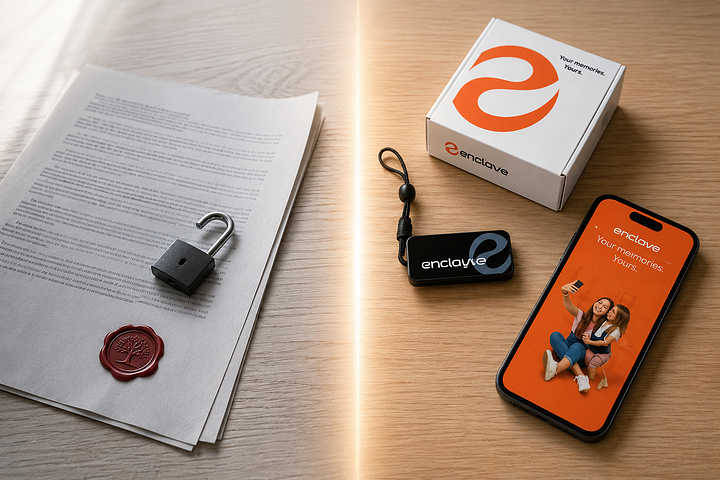
Enclayve starts from a different premise entirely. It isn’t a cloud service with a strict privacy policy — it’s a physical device that lives in your home, and it’s the only place your family’s network actually exists. There’s no server farm holding a copy. There’s no company database with your family’s posts sitting in a row alongside a million other families’ posts. The device you own is the whole system.
That’s the difference between “private” and what Enclayve is actually built around: zero third-party access. Not reduced access, not access limited to a small internal team, not access “only under exceptional circumstances documented in section 14 of the terms of service” — zero. No company, including Enclayve itself, can see what’s posted inside your family’s network. There’s nothing on a server for anyone to see, because there’s no server in the loop at all.
The invite-only piece works the same way, just applied to people instead of infrastructure. Every person on your family’s network was invited there directly by someone who already trusts them. There’s no discovery feed, no suggested connections, no algorithm nudging a stranger’s account toward your child’s profile. If your kid can’t be found by someone who wasn’t already let in, they can’t be contacted by someone who wasn’t already let in either. That’s not a setting you have to remember to turn on — it’s just what the architecture allows.
What This Looks Like Day-to-Day for a Family
Picture a fairly ordinary week. Grandparents in another state want to see photos from a soccer game. A teenager wants to post something for cousins without a classmate ever stumbling across it. A parent wants to be sure that if they ever decide to walk away entirely, their family’s history goes with them — not stays behind on someone else’s server, waiting to be requested back through a support ticket.
On Enclayve, all of that runs through the one device sitting on a shelf at home. The people who can see any of it are the people who were personally invited — nobody else, full stop. If a parent wants to remove someone, they remove them. If a parent wants to shut the whole thing down, they unplug the device, and that’s the end of it — there’s no lingering account somewhere still holding a copy of everything that was ever posted. There’s also no subscription quietly renewing in the background; it’s a one-time purchase, which means there’s no ongoing relationship with a company that could change its mind about what it does with your data down the line, because there’s no data on their end to change their mind about.
This is also where the ownership piece and the safety piece stop being two separate features and start being the same fact. A private family social network that still lives on someone else’s infrastructure is only ever as private as that company’s current policy, current staff, and current owners. A network that physically lives in your house, with zero third-party access built into the hardware itself, doesn’t have that vulnerability — because there’s no “someone else” in the equation to worry about.
Where This Fits If You’re Comparing Options
If you’re the kind of family doing real due diligence here — reading privacy policies, comparing invite systems, checking what happens to your data if a company gets acquired — that instinct is a good one, and it’s worth taking further than most people do. We’ve gone deeper into what “truly private” actually means as a standard, beyond marketing language, in What a Truly Private Social Network Actually Looks Like — worth a read if you want the fuller picture before deciding what actually matters to your family.
It’s also worth knowing that concerns about who can contact kids online aren’t just a “nice to have” instinct — they’re the same concern regulators have been tightening rules around. The FTC’s own guidance on children’s online privacy has, for years, centered on exactly this question: who can access a child’s information, and who can reach them, once they’re on a platform. Families doing their own research on this topic can see the FTC’s Children’s Privacy resources directly.
The Bottom Line
A private family social network should mean exactly what it says — private, meaning nobody else, not “private, with some exceptions we’ll explain in a policy document.” Enclayve is built so that claim is a structural fact instead of a promise: one device, owned outright, holding your family’s entire network, with zero third-party access and no unsolicited contact, ever. Nobody else gets in. Not a stranger, not an algorithm, not even the company that made it.
Protect your family’s memories: enclayve.com
 Sesus Blog — Smart Moves for Founders and Modern Marketers
Leave a comment