


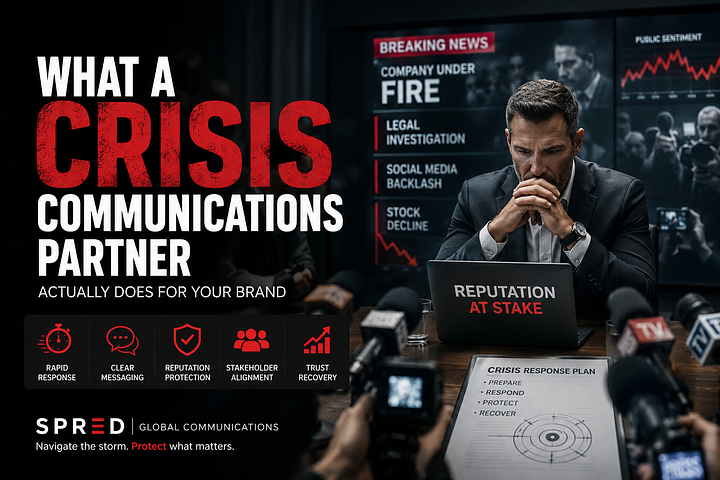
Reputations rarely break in slow motion anymore. A single leaked email, a viral clip, or an unflattering regulatory headline can move faster than most internal teams are built to respond. That’s exactly why organizations bring in outside expertise before a crisis hits — not after. This piece breaks down what a genuine crisis communications partner does, how it differs from traditional PR, and how to evaluate the right fit before you need one.
So what does that outside expertise actually look like in practice? Not a single press release. Not a generic “no comment.” A genuine crisis communications partner operates more like an institutional stabilizer — someone who has managed dozens of high-pressure moments and knows which decisions in the first 24 hours determine whether a story fades or compounds.
Here’s what that role actually involves, how it differs from traditional PR, and how to evaluate whether a partner is the right fit for your organization.
What’s the Difference Between a Crisis Firm and a Traditional PR Agency?
Traditional PR agencies are built for growth — media placements, product launches, brand storytelling. Crisis work runs on a different clock. It’s less about building visibility and more about controlling exposure while protecting institutional credibility under scrutiny.
A firm built for reputational crises typically brings:
- Speed as a discipline, not an afterthought — response infrastructure that’s ready before the phone rings, not assembled after
- Cross-functional fluency, working alongside legal, HR, and executive leadership rather than operating in a marketing silo
- Narrative judgment under pressure — knowing when to respond publicly, when to go quiet, and when silence itself becomes the story
Spred Global Communications operates from that second model — treating crisis response as reputation infrastructure that’s built in advance, not improvised after the fact.
What Core Capabilities Should You Look For?
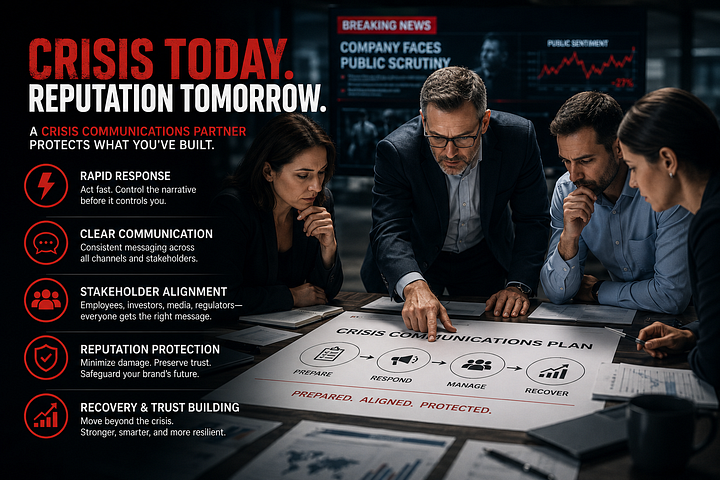
Not every “crisis communications” offering is built the same. When evaluating a partner, look for depth across five areas:
1. Pre-crisis planning. The strongest partners don’t wait for a crisis to start working. They help map vulnerabilities, draft holding statements in advance, and pressure-test leadership through simulated scenarios — so the organization isn’t improvising its first public statement while the story is already trending.
2. Rapid response infrastructure. In the first hours of a crisis, message discipline matters more than message volume. A capable partner coordinates a single, consistent line across every channel — internal memos, media statements, and social response — so the organization isn’t contradicting itself in public.
3. Media relations under pressure. This isn’t the same skill set as pitching a product launch. It means fielding aggressive inquiries, managing on-record and off-record conversations, and preparing spokespeople to hold their composure under direct questioning.
4. Stakeholder coordination. A crisis rarely touches only the public. Employees, investors, regulators, and customers often need distinct, carefully sequenced messaging — and a Spred Global Communications–style partner treats that sequencing as strategy, not an afterthought.
5. Digital and sentiment monitoring. Crises increasingly live online first — in search results, social threads, and now AI-generated summaries of a brand’s reputation. A modern partner tracks sentiment across all of these surfaces in real time, not just traditional news coverage.
What Are the Warning Signs You Need Support Now?
Some organizations wait too long to bring in outside help, treating it as a last resort rather than a preventive measure. Watch for these signals:
- Leadership is fielding media questions without an agreed messaging framework
- Internal teams are giving inconsistent answers to the same question
- A regulatory filing, lawsuit, or internal investigation is likely to become public
- Social sentiment is shifting faster than your internal team can monitor it
- There’s no documented crisis communication plan sitting ready before something happens
If more than one of these applies, the right move is usually preparation, not just reaction.
How Do You Evaluate and Choose the Right Partner?
A structured evaluation beats a gut-feel decision when reputation is on the line. Ask prospective partners to walk through:
- Track record with comparable stakes. Have they handled situations of similar visibility and complexity — not just similar industry?
- Speed of activation. How quickly can they mobilize a response team, and what does that team actually look like?
- Integration with legal counsel. Do they know how to align public messaging with legal exposure, rather than creating conflict between the two?
- Post-crisis capability, not just crisis response. Reputation recovery is a distinct skill from initial containment — ask how they handle the months after the headlines fade.
- Transparency about limits. Be cautious of any firm promising to “make a story disappear.” Credible partners talk about managing outcomes, not guaranteeing them.
What Does Working With a Crisis Partner Look Like in Practice?
In practice, the relationship often starts before any crisis exists — through an audit of potential vulnerabilities, a documented response framework, and identification of trained spokespeople. When an incident occurs, the partner typically embeds directly with leadership: shaping the first statement, managing media relations during a crisis, and coordinating messaging across every stakeholder group simultaneously.
Once the acute phase passes, the work shifts toward trust rebuilding after a crisis — monitoring how sentiment recovers, addressing residual coverage, and helping the organization demonstrate the changes it promised. That full-cycle presence — before, during, and after — is what separates a genuine crisis communications partner from a firm that only shows up once the story breaks.
Frequently Asked Questions
How quickly should a crisis communications partner be able to respond? Ideally within hours, not days. Firms with pre-built response protocols and on-call teams can typically issue an initial holding statement within the first few hours of an incident.
Do small and mid-sized organizations need this kind of support, or only large corporations? Reputational risk isn’t limited to large brands. Smaller organizations often have less infrastructure to absorb a crisis, which can make outside support even more valuable relative to their size.
Is crisis communications only relevant during an active crisis? No — the strongest engagements start well before anything happens, through planning, spokesperson training, and vulnerability assessments that reduce the odds of a crisis escalating in the first place.
What’s the difference between reputation management and crisis communications? Reputation management is ongoing and proactive; crisis communications is a specialized subset focused specifically on acute, high-stakes events and their aftermath.
Ready to build a crisis communication plan before you need one? A prepared organization moves faster — and recovers stronger — than one that’s improvising under pressure.
 Sesus Blog — Smart Moves for Founders and Modern Marketers
Leave a comment