



Valuation does not usually fall apart overnight. Most of the time it drifts — slowly, quietly — because the people who should be shaping the story around a company left that job to someone else.
If you are a senior executive, you already know that markets are not just reading your quarterly numbers. They are reading everything — how your CEO talks in an interview, whether your regulatory disclosures line up with your media messaging, what analysts write in the gaps between earnings calls. A strong investor relations narrative strategy is what ties all of that together. Without it, you are not just missing a communications opportunity. You are carrying a risk that compounds over time.
The shift in how institutional investors consume information has made this gap harder to ignore. They are not waiting for your next earnings call to form a view. They are building one continuously — from your press coverage, your ESG disclosures, your executive visibility, your social sentiment. By the time you show up with a formal investor presentation, the room already has an opinion. The question is whether that opinion was shaped by you or by whoever was loudest in your absence.
That is the strategic problem this piece addresses. Not communications theory — but the real, measurable cost of leaving your narrative unmanaged at the leadership level.

The Hidden Driver of Valuation Instability
Markets price coherence as much as they price performance. This is not an abstract claim. You can observe it across earnings cycles, M&A announcements, and regulatory events. When a company’s external narrative is consistent, investors assign lower interpretive risk to new information. When it is fragmented, every new disclosure forces reinterpretation — and that uncertainty gets priced in.
This is where investor communications becomes the most visible test of narrative discipline. The gap between what you intend to communicate and what markets actually receive is rarely caused by dishonesty. It is caused by misalignment — between what your CFO frames in an earnings call and what your CEO says to a journalist the next morning, between your IR deck and the story your media coverage is telling. That gap creates what institutional investors experience as interpretive friction. They cannot reconcile conflicting signals, so they discount. Not loudly. Not in a single announcement. But persistently — as a quiet drag on how your organization’s forward prospects get valued.
The companies most exposed to this are often ones with strong financial performance and weak narrative infrastructure. Their numbers are solid. Their story is not. And in a market environment where perception increasingly moves ahead of performance, that gap carries real consequences.
The leaders who recognize this make one structural adjustment: they stop treating investor communications as a reporting function and start treating it as a reputation function with direct financial stakes. That shift changes who owns the mandate, what gets resourced, and how success is defined.

Where Investor Communications Break Down
The breakdown rarely happens at the point of formal disclosure. It happens in between — in the weeks and months when markets are forming views and your organization is not actively shaping them.
Capital market perception is not built from quarterly reports alone. It is built from the signals that analysts, media, and institutional investors encounter between your formal communications events. Executive conference appearances, regulatory commentary, third-party analyst notes, media interviews — all of it feeds into a perception model that runs continuously, not on your reporting schedule.
Most organizations are not built to manage this. IR teams are structured around reporting cycles. Communications teams are structured around reactive media management. The result is a persistent gap during the periods that matter most — when markets are uncertain, when a competitor has made a move, or when a regulatory development has introduced ambiguity that needs contextualizing.
Spred works with organizations specifically to close that gap, treating the intervals between formal investor events as active narrative territory rather than dead time between disclosures.
The deeper structural problem is that the functions responsible for investor communications, media relations, and executive visibility rarely coordinate around a shared narrative architecture. They run in parallel, each optimizing for its own objectives — and the result is a fragmented signal environment that sophisticated investors learn to treat with caution.
The fix is not to centralize communications control. It is to build a shared narrative framework that each function can operate within independently while staying coherent at the market level. That distinction matters. Control creates bottlenecks. A shared framework creates alignment.
“The most expensive narrative failure is the one no one inside the organization recognized as a failure at all.”
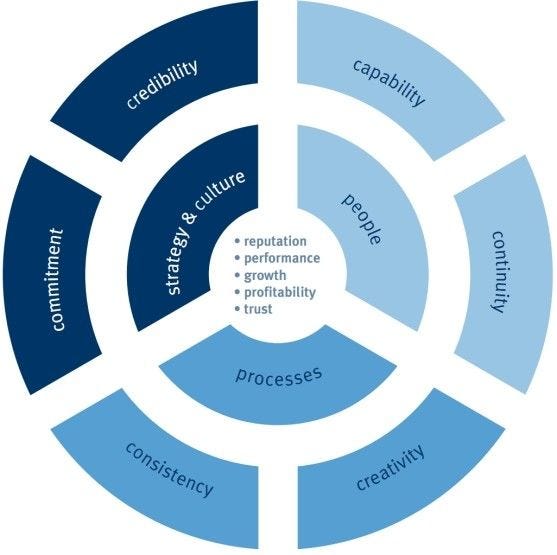
Narrative Alignment as a Strategic Discipline
Treating investor relations as a narrative discipline starts with accepting one uncomfortable premise: the market’s interpretation of your organization is a strategic output that can be designed — not just a reaction you have to manage after the fact.
Narrative alignment is the practice of ensuring that your investor communications, media coverage, executive visibility, and regulatory positioning all operate from the same strategic frame. It is not message control. It is architecture — building a consistent interpretive context so that when new information enters the market, it lands inside a frame that investors already understand and trust.
Organizations that have invested in this consistently hold their valuation more steadily during periods of market uncertainty. Not because they suppress negative information — but because they have built the interpretive infrastructure that lets investors contextualize it without defaulting to discount.
Spred Global Communications has observed that the organizations most effective at narrative alignment treat it as a cross-functional discipline with governance, ownership, and a defined operating rhythm — not as a communications campaign they launch when something goes wrong.
The practical implication is direct: narrative alignment must be built before you need it. If you begin designing your investor narrative during a valuation crisis, you are already behind. The credibility infrastructure required to anchor market interpretation under pressure — consistent executive positioning, a coherent media presence, a track record of reliable communications — takes time to build. Leaders who wait until the pressure arrives find that the market has already formed its view, and repositioning a narrative under scrutiny is significantly more expensive than maintaining one during stability.
“Narrative alignment is not what you say when markets are watching. It is what you have already built before they looked.”
Building a Narrative System That Holds Under Pressure
Moving from reactive investor communications to proactive narrative architecture requires three decisions at the executive level.
The first is definitional. You need to formally define your investor relations narrative strategy as a strategic function — not a reporting one. That means assigning executive ownership, establishing cross-functional coordination between IR, communications, legal, and the C-suite, and creating a shared narrative framework that guides all external positioning, not just what goes into the investor deck.
The second is operational. You need a continuous signal monitoring capability that tracks how your organization is being perceived across analyst reports, media coverage, and investor sentiment between reporting cycles — not just after them. This capability should feed directly into your executive communications calendar, so that proactive narrative inputs are scheduled around the moments when market interpretation is most active.
The third is relational. The organizations with the most durable investor narratives reinforce them through consistent, structured engagement with the analysts and institutional investors who most influence market perception. This is not about producing more communications volume. It is about more disciplined, better-timed engagement with the right audiences at the right points in the market cycle.
One action you can take this week: run a narrative audit. Map every external signal your organization produced in the last 90 days — earnings communications, executive interviews, media coverage, regulatory disclosures — and ask whether they cohere around a single, defensible strategic frame. The gaps in that audit are where your valuation risk is sitting right now.
Valuation is increasingly a narrative outcome. The organizations that manage this deliberately — building coherent, consistent, cross-functional narrative systems before scrutiny arrives — are seeing measurable advantages in how markets price their forward prospects. Those that continue treating investor communications as a disclosure obligation will find the gap between their performance and their valuation increasingly hard to explain.
For organizations navigating this intersection of reputation strategy and capital market positioning, working with a media relations consulting firm that understands both sides of that equation is often where the work begins. Spred helps businesses secure guaranteed visibility in major outlets including Forbes, Bloomberg, Business Insider, and the Wall Street Journal — building the kind of credibility that translates directly into how markets, investors, and institutional stakeholders perceive and price your organization.
For leaders navigating valuation pressure, the real question is not what the market sees — but who is shaping what it believes.
 Sesus Blog — Smart Moves for Founders and Modern Marketers
Leave a comment