


Immigration officers read hundreds of petitions a month, and spreadsheets blur together fast. But a founder whose work has already been covered by outlets the officer recognizes stands out before the legal argument even starts. Here’s why media strategy deserves a place at the very beginning of the EB-2 NIW process — not the end.
This is the part of the EB-2 NIW process most founders get backwards. They treat media coverage as a nice-to-have — something to chase after the petition is drafted, if there’s time and budget left. In practice, it should be one of the first pieces of evidence you build, because it does something a business plan alone cannot: it shows an independent third party already recognizes your work as significant.
Here’s what you’ll learn: why officers respond to earned media the way they do, how petition-grade coverage differs from a paid press release, which publications actually carry weight, and how to sequence a media strategy so it’s ready before you file.
Why USCIS Officers Respond to Media Coverage
The Matter of Dhanasar framework asks petitioners to prove three things: that the endeavor has substantial merit and national importance, that the founder is well-positioned to advance it, and that waiving the job offer requirement benefits the United States. National importance is the hardest prong to prove with self-authored documents alone — a business plan is, by definition, the founder’s own claim about their own work.
Earned media coverage breaks that circularity. When a respected outlet independently decides your work is worth covering, that’s evidence you didn’t write yourself. An officer doesn’t have to take your word for the impact of your venture — a journalist, editor, or industry publication already made that judgment call.
This is why petitions built around earned media coverage tend to move faster and draw fewer requests for evidence. The coverage does work that legal argument can’t do on its own: it corroborates the claim instead of just asserting it.
The Difference Between Paid PR and Petition-Grade Media
Not all press is equal, and officers who review enough files start to recognize the difference.
A paid placement — a sponsored feature, a pay-to-play “top founders” list, a press release distributed and never edited — reads exactly like what it is: marketing. It doesn’t demonstrate that anyone outside your own team decided your work mattered.
Petition-grade media looks different:
- An editor or reporter chose to cover you based on newsworthiness, not payment
- The coverage appears in a publication with editorial standards relevant to your industry
- The story includes independent framing, not reproduced press-kit language
- The outlet is one a USCIS officer would recognize as legitimate, not an obscure content farm
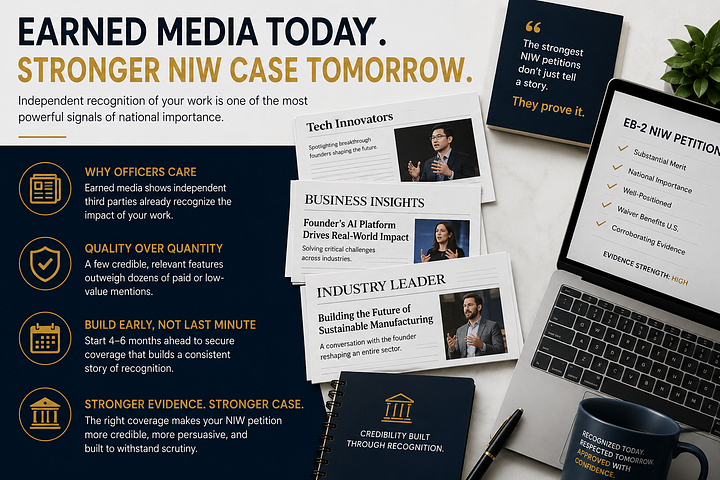
Founders who go the paid-placement route often find out the hard way that volume doesn’t substitute for credibility. Three real features in outlets your industry respects will outweigh fifteen paid mentions nobody in USCIS — or anyone else — takes seriously.
Which Publications Actually Move the Needle
The right outlets depend entirely on your sector, and that’s where most founders waste time chasing prestige instead of relevance. A biotech founder featured in a general business blog gains far less than one covered in a life-sciences trade publication read by people who actually understand the field.
The approach that works is building three “credibility pillars” — outlets that match your specific niche and would make an officer nod without needing an explanation of why the publication matters. For a fintech founder, that might mean a finance-focused outlet and a technology publication with policy credibility. For someone in advanced manufacturing, it might mean an industry trade journal alongside a regional business publication covering economic impact.
This is where 9-Figure Media approaches things differently from a generic PR agency: instead of pitching broadly and hoping for a hit, the process starts by mapping the three outlets an officer in your exact field would recognize as authoritative — then engineers the narrative and pitch to land coverage there specifically.
Building a Media Timeline Around Your Filing Date
Media strategy fails when it’s compressed into the weeks before filing. Editorial coverage takes time — pitches need to land with the right timing, stories need to be developed, and a single feature rarely appears the week you ask for it.
A workable timeline looks like this:
- Months 1–2: Identify your credibility pillars and begin outreach with a clear, newsworthy angle — not a generic “founder profile” pitch
- Months 3–5: Land your first three to five earned features, prioritizing outlets your specific industry respects
- Months 6+: Layer in supporting recognition — panel appearances, industry commentary, follow-up coverage — that reinforces the initial placements
Founders who start this process early arrive at filing with a body of coverage that tells a consistent story. Founders who start late end up scrambling for anything that will run in time, which is exactly how petitions end up built on weak, easily-dismissed sources.
Common Media Strategy Mistakes That Weaken NIW Petitions
A few patterns show up again and again in petitions that draw RFEs or outright denials:
- Relying on vanity metrics. A press release with a high “reach” number means nothing to an officer if no credible outlet actually ran the story.
- One-off placements with no narrative thread. Three unrelated mentions in unrelated outlets don’t build a case the way three coordinated features in industry-relevant publications do.
- Mismatched publications. Coverage in an outlet with no connection to your field does less to establish national importance than one piece in a publication your industry actually reads.
- Treating media as an afterthought. Founders who wait until the petition is nearly finished to think about press coverage run out of runway to land anything credible.
The founders who get this right treat media the same way they’d treat any other piece of national importance evidence — planned, sequenced, and built to withstand scrutiny, not assembled at the last minute.
What a Petition-Ready Media Portfolio Looks Like
Before filing, a strong media portfolio should include:
- Three to five pieces of earned, independently-edited coverage in outlets relevant to your industry
- A clear narrative thread connecting the coverage to your venture’s specific contribution
- Coverage that appears months — not days — before the petition is filed, showing sustained recognition rather than a last-minute push
- No reliance on paid placements or self-published content as primary evidence
FAQ
Does paid press coverage count as evidence for an EB-2 NIW petition? It can be included, but it carries far less weight than earned editorial coverage, since it doesn’t demonstrate independent third-party recognition.
How many media features does a founder typically need? There’s no fixed number, but three to five pieces of relevant, credible coverage tends to build a meaningful pattern of recognition without diluting focus.
How far in advance should media strategy start before filing? Ideally four to six months, since editorial coverage takes time to develop and a rushed timeline usually produces weaker, less relevant placements.
Can media coverage replace other forms of NIW evidence? No — it works alongside letters of recommendation, business plans, and other Dhanasar-aligned evidence, but it’s often the piece that makes the rest of the file more credible.
Bottom Line
A business plan tells USCIS what you claim about your work. Earned media coverage tells them what an independent outlet already decided about it — and that distinction is often what separates a smooth approval from a drawn-out RFE. If you’re building toward a filing date, the time to start on media is now, not after the legal draft is done.
9-Figure Media works with founders to identify the right credibility pillars for their industry and secure the placements that make a petition file stand on its own. Learn how the process works.
 Sesus Blog — Smart Moves for Founders and Modern Marketers
Leave a comment